
Backup Internet for Baton Rouge Businesses
Business Technology, Baton Rouge Connectivity
Should Your Baton Rouge Business Have a Backup Internet Connection?
Most Baton Rouge businesses run on a single internet line and hope for the best. In a city where thunderstorms, hurricanes, and construction-related cable cuts are routine, that is more of a gamble than a strategy. In this article, I will walk through what a backup internet connection actually is, how local businesses are using modern failover options, which business types benefit most, and how to weigh the real cost against the risk of downtime.
What a Backup Internet Connection Really Is
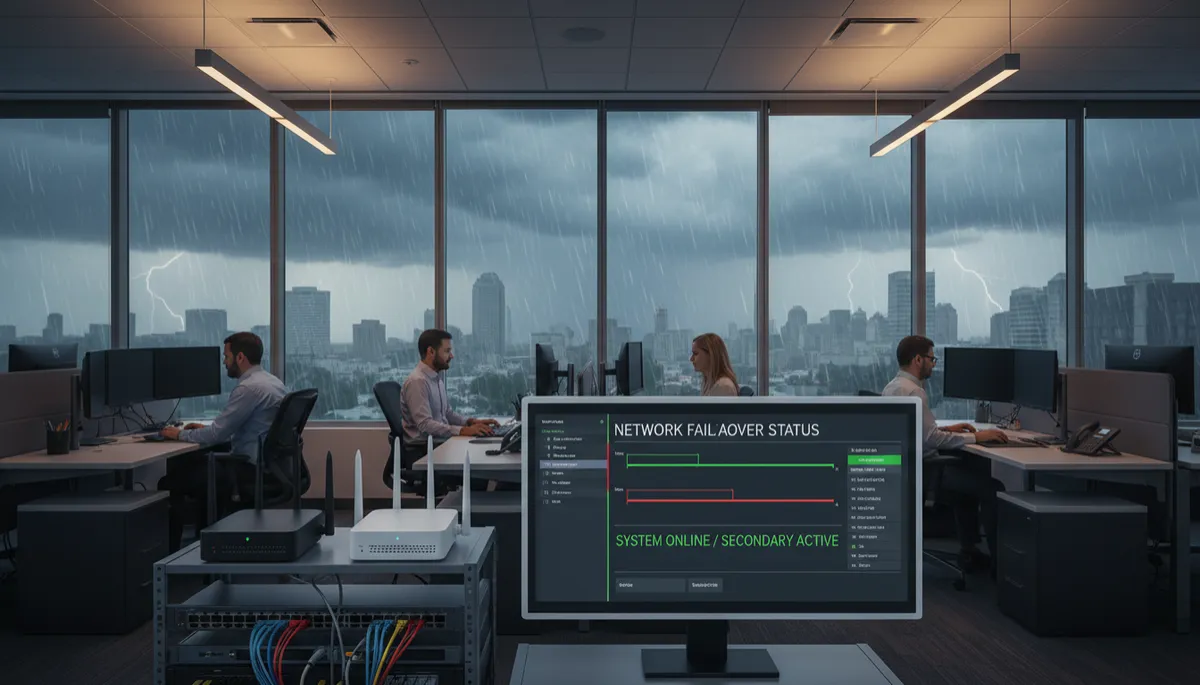
A backup internet connection is a second path to the internet that automatically takes over when your primary service goes down. Think of it as a generator for your data instead of your lights. The key word is automatic. True business internet failover uses a router or SD-WAN device that constantly monitors your main circuit. If it detects an outage, it shifts traffic to the backup without your staff having to touch anything.
In Baton Rouge, primary connections typically come from fiber or cable providers such as AT&T, Cox, Spectrum, or REV. A backup internet connection usually rides over a different technology or carrier so the same storm, fiber cut, or neighborhood outage is less likely to take both down at once. That diversity is what actually improves business continuity, not just having “more bandwidth.”
How Businesses Use LTE/5G Failover, Secondary ISPs, and SD-WAN
Most Baton Rouge businesses that invest in redundancy use one of three models: cellular LTE failover, a secondary wired ISP, or SD-WAN that can intelligently juggle multiple links.
Cellular LTE/5G Failover
LTE failover (and now 5G) uses a router with a SIM card from a wireless carrier. When your wired internet fails, the router automatically routes your traffic over the cellular network. With strong T‑Mobile, Verizon, and AT&T wireless coverage across Baton Rouge, this has become a practical and cost-effective option for many small and mid-sized businesses. Typical business plans run roughly $40–$100 per month depending on data needs, with hardware adding to the upfront cost.
The trade-off: cellular backup usually has lower speeds and data caps compared with your main fiber or cable line. It is ideal for keeping card terminals, cloud apps, phones, and a few workstations online, not for streaming or large backups during an outage.
Secondary ISP on a Different Network
A more robust approach is adding a second wired provider. For example, a business might pair AT&T Fiber with Cox cable, or Cox with Spectrum or REV where available. This gives you two high-speed circuits, ideally delivered over different physical paths. Monthly costs typically land between $80 and $300 for the backup line, depending on speed and contract.
With the right router, you can configure active–passive failover or active–active load balancing. Active–active means both connections are used all the time, improving performance, while still providing business internet failover if one drops.
SD-WAN for Smarter Reliability
SD-WAN (software-defined WAN) takes this a step further. It can monitor multiple links in real time and route critical applications over the best-performing path. If your primary fiber starts to degrade or fail, SD-WAN automatically shifts VoIP, payment traffic, or EMR access onto LTE or your secondary ISP with minimal disruption. Industry research shows SD-WAN can reduce costs by mixing lower-cost circuits while improving uptime and application performance through dynamic routing and built-in security.
SD-WAN appliances and subscriptions add to your budget, but for multi-location businesses or those with strict uptime requirements, the added control and visibility often justify the investment.
Which Baton Rouge Businesses Benefit the Most?
Not every business needs the same level of redundancy. The more your revenue and operations depend on real-time connectivity, the stronger the case for a backup internet connection.
- Restaurants with online ordering and delivery platforms: If your POS, online ordering, and third-party delivery apps all rely on the cloud, a 30-minute outage during lunch or dinner can mean dozens of lost tickets, angry customers, and backed-up kitchen staff.
- Medical and dental offices: Most practices in Baton Rouge now depend on electronic medical records, e-prescribing, and cloud-based imaging or scheduling. If your internet goes down, you may not be able to access charts, verify insurance, or submit claims, which quickly disrupts patient care and cash flow.
- Retailers with card-only or card-heavy operations: When card terminals, mobile readers, and e-commerce platforms are all internet-dependent, an outage often means you cannot take payments at all. In today’s “no cash on hand” environment, that can effectively close your doors until service is restored.
Other strong candidates include professional offices with remote staff, warehouses relying on cloud inventory systems, and any operation with VoIP phone service. If the question, “What happens if our internet is down for three hours on a Friday?” makes you uneasy, redundancy is worth a closer look.
Cost vs. Risk: A Practical Assessment
Industry data shows that small and mid-sized businesses can usually add basic automated backup for roughly $35–$85 per month, with more advanced setups ranging higher. Hardware for proper failover or SD-WAN might run $1,500–$3,500 as a one-time cost, depending on scale and features. Those numbers need to be compared with what downtime actually costs your operation in Baton Rouge.
Start with a simple calculation: estimate your average hourly revenue, then factor in how many staff hours are effectively wasted when systems are offline. Add soft costs such as lost online reviews, delayed medical visits, or customers who quietly switch to a competitor that “never seems to be down.” In many cases, one or two significant outages per year can exceed the annual cost of a well-designed backup solution.
At the same time, not every business needs a premium SD-WAN stack or dual gigabit fiber. A modest LTE failover circuit sized to keep your POS, EMR, or core cloud apps running may be enough. The goal is not to overspend on technology; it is to align your level of redundancy with your actual risk tolerance and revenue exposure.
Getting Help Evaluating Your Connectivity Landscape
Baton Rouge has a crowded mix of fiber, cable, fixed wireless, and cellular options, and each address is a little different. That is why the right backup internet connection for a downtown restaurant will not look the same as the right setup for a medical office near Bluebonnet or a retailer along Airline Highway. I work with local owners to map out their connectivity landscape, payment flows, and critical applications, then recommend practical business internet failover designs that fit their budget and risk profile.
Want to know whether a backup internet connection makes sense for your operation? Reach out to Kurt Howard, Local Business Technology Advisor.